
Art in Action: Creative Exploration at Preschool
How preschool children experiment with colour, texture, movement and creative materials through hands-on art experiences at Pegasus International Preschool.
Art experiences in preschool give children opportunities to explore ideas through colour, texture, movement and materials. Rather than focusing only on producing a perfect finished picture, children can investigate what paint feels like, observe how colours change and discover the different marks that tools and objects can create.
In a preschool environment in Singapore, hands-on art activities can support creativity, communication, sensory awareness and physical coordination. Children may paint with brushes, move objects through paint, construct three-dimensional pieces or combine familiar materials in unexpected ways.
The photographs on this page capture moments of experimentation, concentration and shared discovery. Through guided creative experiences, children may develop confidence in making choices and expressing ideas while learning that art can be explored in many different ways.
What Does “Art in Action” Mean in Preschool?
Art in action is about children actively exploring the creative process. They are not simply copying a model or following a fixed set of steps. Instead, they may be invited to experiment with materials, make decisions and observe what happens when they try different movements or combinations.
A preschool art experience might begin with a simple invitation:
A simple creative invitation
- What marks can this object make?
- What happens when two colours meet?
- How can we change the texture of the paint?
- Can a round object be used as an art tool?
- How might soft materials be joined to create a model?
These questions encourage children to participate as explorers and creators — see how inquiry-based learning encourages exploration. The process of trying, adjusting and discussing can be just as valuable as the finished work.
The photographs show a range of creative experiences, including painting with objects, combining colours and constructing forms with soft materials.
Exploring Colour Through Hands-On Painting
Colour exploration helps children notice similarities, differences and changes. During painting activities, they may observe that colours look different when spread thinly, placed side by side or mixed together.
Children may be encouraged to:
Ways children explore colour
- Choose colours independently.
- Move paint across a large surface.
- Compare light and dark shades.
- Notice what happens when colours overlap.
- Describe colours using familiar objects or experiences.
- Work alongside classmates on a shared artwork.
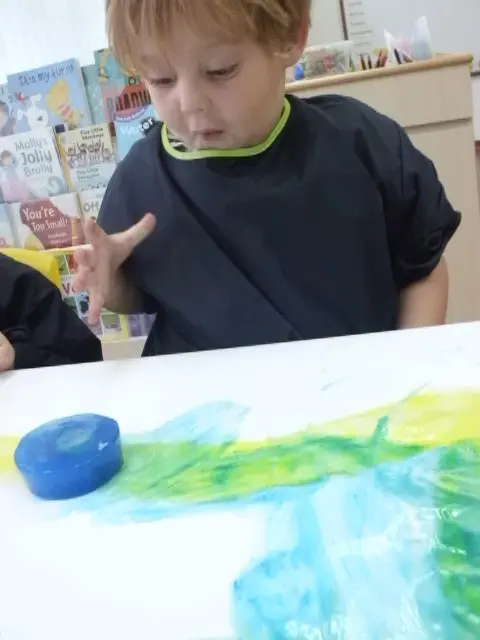
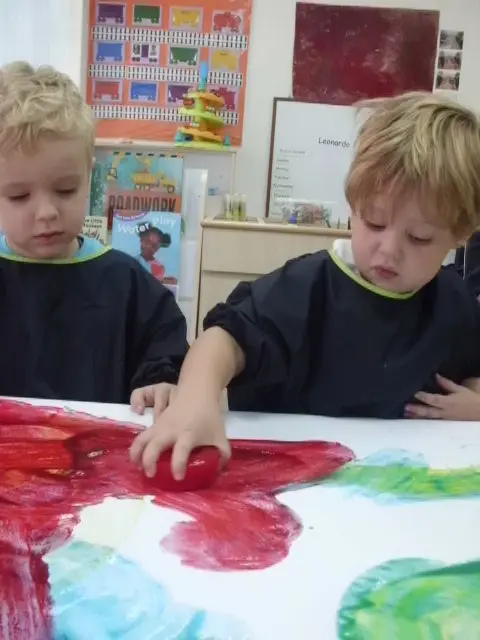
The images capture children moving painted objects across paper and observing the trails they leave behind. Activities such as these allow children to see a direct relationship between their movement and the marks appearing on the surface.
Rather than expecting every child to create the same picture, teachers can allow space for different approaches. One child may press firmly, another may move slowly, and another may focus on mixing several colours.
Using Everyday Objects as Creative Tools
Preschool art does not need to rely only on conventional paintbrushes. Everyday objects can be introduced as tools for printing, rolling, stamping, spreading or making patterns.
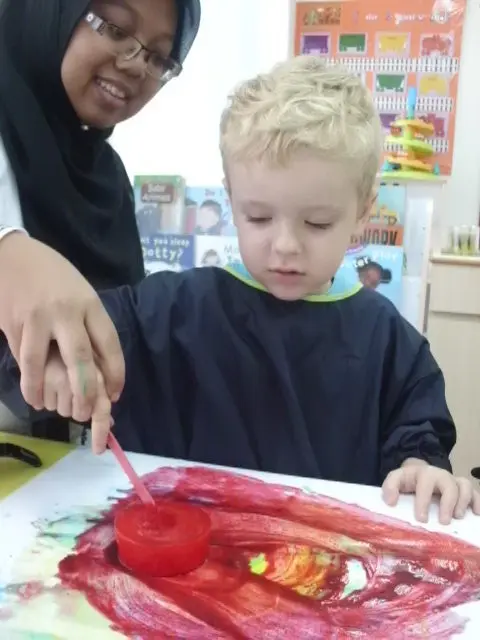
The photographs appear to show children using rounded objects or containers to move paint across a surface. This type of activity may prompt children to investigate:
What children investigate
- The shape of the object.
- How it moves.
- The amount of pressure needed.
- The direction of the paint.
- Whether it creates lines, circles or broad areas of colour.
Using unusual art tools can make children more aware of cause and effect. They can see how changing their hand movement changes the result.
It also reinforces the idea that materials can have more than one purpose. An object usually used for play or storage may become part of a creative investigation.
Sensory Learning Through Paint and Materials
Art can be a highly sensory experience. Children may notice the smoothness of wet paint, the softness of cotton, the resistance of paper or the difference between moving an object through thick and thin paint.
Sensory exploration can support children as they build descriptive language and become more aware of physical properties.
They may use words such as:
Words children may use
For younger preschool children, sensory discovery may be the central part of the activity. They may be interested in touching, moving and observing materials before they are ready to explain their ideas in detail.
Teachers can support this process by introducing vocabulary naturally and allowing children enough time to investigate.
Developing Fine-Motor Skills and Coordination
Creative activities often involve controlled hand, finger and arm movements. When children hold a brush, guide an object, attach a small piece or arrange materials, they are practising coordination.
Art experiences may support children in developing:
Skills children develop
- Hand-eye coordination.
- Finger strength.
- Controlled wrist movement.
- Bilateral coordination using both hands.
- Awareness of pressure and direction.
- Careful placement of small materials.
The photographs show children reaching, pressing, guiding and positioning objects during creative work. These actions may help prepare children for other tasks involving control, including drawing, writing, cutting and self-care routines.
The aim, however, should not be to turn every art activity into a formal exercise. Physical development can emerge naturally while children remain focused on the creative experience.
Making Choices and Expressing Ideas
Art gives children opportunities to make decisions. They may decide which colour to use, where to place an object or whether to continue adding materials.
These choices allow children to communicate ideas even before they can explain everything verbally.
A child’s artwork does not always need to represent a recognisable person, animal or scene. Abstract marks, mixed colours and experimental arrangements can also reflect genuine thinking and discovery.
Teachers may invite children to talk about their process by asking:
Talking about the process
- Tell me about what you are making.
- Which part did you begin with?
- What did you notice when you moved the object?
- How did you choose these colours?
- Would you like to add anything else?
These prompts show interest without deciding what the artwork is supposed to mean.
Collaborative Art and Social Learning
Some creative experiences are individual, while others involve children sharing space, tools and materials.
The gallery includes moments where children appear to be working beside one another on a large painted surface. Collaborative art can help children practise:
Social skills in shared art
- Waiting for access to shared materials.
- Observing what classmates are doing.
- Contributing to a common piece.
- Respecting another child’s working space.
- Sharing discoveries.
- Solving simple disagreements.
A shared artwork may change continuously as different children add marks and colours. This gives children experience of contributing to something larger than their own individual work.
Teachers can guide cooperation while still allowing each child’s contribution to remain visible.
Connecting Art with Play-Based Learning
Play-based learning encourages children to investigate through active participation. Art fits naturally within this approach because children can make choices, test ideas and adapt their actions — discover our play-based learning approach.
When a child moves an object through paint, for example, the experience may involve creativity, physical coordination, sensory discovery and early scientific thinking at the same time.
The child may ask, either verbally or through action:
Questions through play
- What happens when I push harder?
- Will the colour spread further?
- Can I make the same mark again?
- What if I use another colour?
- How can I cover a larger area?
The activity remains playful, but meaningful learning is taking place through experimentation.
Art Within a Reggio Emilia-Inspired Environment
In a Reggio Emilia-inspired approach, children are recognised as capable communicators who can express ideas in many ways — learn about our Reggio Emilia-inspired approach. Spoken language is only one form of communication. Drawing, painting, movement, construction, modelling and imaginative play may also help children represent their thinking.
This idea is sometimes associated with the many “languages” children use to explore and communicate.
Art materials are therefore not treated only as items for occasional craft lessons. They can become tools for investigation, documentation and reflection.
Teachers may provide thoughtfully arranged materials and observe how children use them. A child’s interest in colour, movement or texture may lead to further experiences, such as:
Where interests may lead
- Mixing new shades.
- Studying patterns.
- Painting on different surfaces.
- Creating three-dimensional forms.
- Connecting art with a story or nature topic.
- Revisiting an earlier artwork.
The learning may develop over time rather than ending as soon as one activity is completed.
The Teacher’s Role in Creative Exploration
Teachers support preschool art without controlling every decision. Their role may include preparing suitable materials, ensuring safety and helping children think more deeply about what they are doing.
A teacher can guide exploration by:
How teachers guide exploration
- Demonstrating how to use unfamiliar materials safely.
- Offering a manageable selection of choices.
- Introducing relevant words.
- Observing children’s actions and interests.
- Asking open-ended questions.
- Helping children manage shared materials.
- Documenting comments or stages of the process.
- Encouraging children to revisit an idea.
The photographs show adults providing support while children remain actively involved in handling the tools and materials.
This balance is important. Children receive help when needed, but they also have room to experiment rather than being given every answer or instructed to reproduce an identical model.
Creative Construction and Three-Dimensional Art
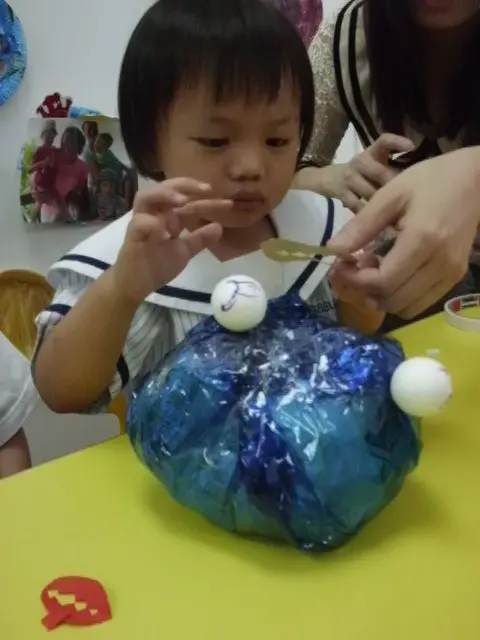
Art is not limited to paint and paper. Three-dimensional construction allows children to explore shape, form, balance and how different materials can be joined.
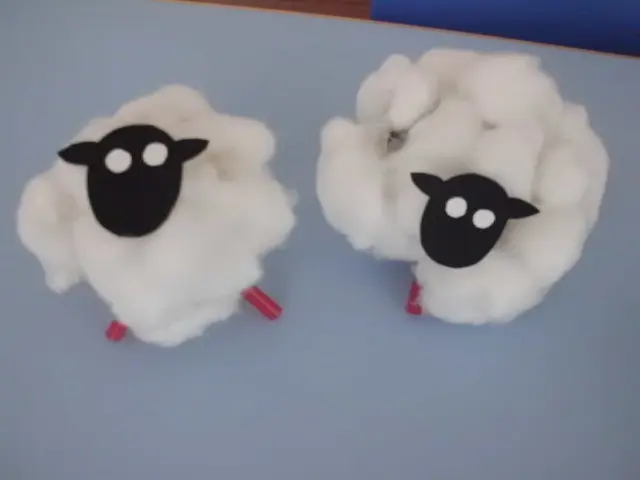
The soft sheep models shown in the gallery demonstrate how familiar materials may be combined to create a recognisable form. Children may explore how flat shapes and textured materials work together.
Construction activities can involve:
Construction activities
- Selecting suitable pieces.
- Arranging parts.
- Attaching materials.
- Comparing sizes and positions.
- Noticing symmetry.
- Discussing features of an animal or object.
Where an adult-prepared example is used, children should still be given opportunities to contribute choices and handle appropriate parts of the process.
Continuing Art Exploration at Home
Parents can encourage creativity at home without buying complex art sets. Simple materials and enough time to explore are often more useful than highly structured craft kits.
Families might offer:
- Washable paint.
- Large sheets of paper.
- Cardboard.
- Sponges.
- Cotton.
- Recycled containers.
- Safe natural materials.
- Crayons or chalk.
- Child-safe glue.
Parents can place a small selection of materials on a protected surface and allow the child to decide how to use them.
Useful questions include:
Questions to ask at home
- What are you noticing?
- How did you make that mark?
- What might you try next?
- Which material feels different?
- Would you like to tell me about your work?
It is helpful to avoid immediately asking, “What is it?” Some artwork may be focused on colour, movement or texture rather than representing a specific object.
Parents can instead show interest in the process and allow children to explain the work in their own way. You can also explore the Pegasus preschool curriculum to see how creative experiences are part of everyday learning.
Photo Gallery
The gallery below captures children experimenting with paint, colour, movement and creative materials. The photographs show moments of individual concentration, adult-supported exploration, collaborative painting and three-dimensional construction using a variety of tools and textures.
Frequently Asked Questions
What do children learn from preschool art activities?
Preschool art activities may support creativity, fine-motor coordination, sensory awareness, decision-making and communication. Children can also learn about colour, shape, texture, movement and cause and effect through hands-on experimentation.
What is process art for preschool children?
Process art focuses on exploration rather than requiring every child to produce the same finished item. Children are encouraged to experiment with materials, make choices and discover different ways to create marks, forms and textures.
How does art support play-based learning?
Art supports play-based learning by allowing children to test ideas through action. They may mix colours, move tools, arrange materials and change their approach based on what they observe during the activity.
How is art connected to the Reggio Emilia approach?
A Reggio Emilia-inspired approach recognises art as one of the many ways children communicate and investigate ideas. Paint, drawing, construction and other creative materials can help children represent their observations, questions and experiences.
How can parents encourage creativity at home?
Parents can provide simple open-ended materials such as paper, washable paint, crayons, cardboard and recycled objects. Allowing children to make choices and asking questions about the process can be more helpful than expecting a particular finished result.
See Creative Learning in Action
Parents can learn more about how creative experiences are included within the inquiry-based, play-based and Reggio Emilia-inspired curriculum at Pegasus International Preschool. You are welcome to visit the school, view the learning environment and speak with the team about the programme suitable for your child’s age group.